1 “Is this true?” the high priest asked.
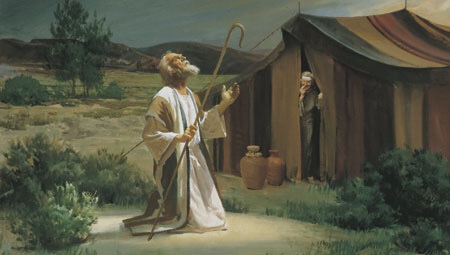
2 “Brothers and fathers,” he said, “listen: The God of glory appeared to our father Abraham when he was in Mesopotamia, before he settled in Haran, 3 and said to him:
“Get out of your country
and away from your relatives,
and come to the land
that I will show you.”
4 Then he came out of the land of the Chaldeans and settled in Haran. From there, after his father died, God had him move to this land you now live in. 5 He didnt give him an inheritance in it, not even a foot of ground, but He promised to give it to him as a possession, and to his descendants after him, even though he was childless. 6 God spoke in this way:
“His descendants would be strangers
in a foreign country,
and they would enslave
and oppress them 400 years.
7 I will judge the nation
that they will serve as slaves, God said.
After this, they will come out
and worship Me in this place.”
8 Then He gave him the covenant of circumcision. After this, he fathered Isaac and circumcised him on the eighth day; Isaac did the same with Jacob, and Jacob with the 12 patriarchs.”
Acts 7:1-8
—
There is a lot of trust, faith even, that begins God’s story of redemption through Abram and his future offspring. From the very beginning, faith has been the hinge-point. Abram and his family had to trust God when they left where they were living to begin this new life with Him in the lead. They relocated again after his father died in Haran before settling in Canaan. But even then, Abram lived as a nomad, travelling with his flocks and herds as the seasons changed, in the land God promised to his descendants. Then God promises, along with the land and it’s abundance, a period of oppression and slavery under a foreign thumb.
What kind of promise is that?
“I’m going to set you and your family here, but first, you are going to be slaves.”
Would you want to listen to that promise? Would you even consider it as an option? Probably not.
But Abram did…and we ask “Why?”
Because Abram knew that he was dealing with YHWH Elohim, and not some capricious human being or false god. He wasn’t going to move him around just to mess with him. He wasn’t going to allow his grandchildren and great grandchildren to go into slavery just because He thought it might be fun. YHWH Elohim had a greater plan in mind and Abram believed him. Hebrews tells us that God credited it to him as righteousness. Trust and faith cannot be separated. It would be silly to say otherwise. Trust is part of the definition of faith. And Abram had faith that God’s plan was bigger and better than anything he could ever have divised for himself, and that if there was something difficult to deal with along the way, that God had a greater purpose in mind for it. God didn’t cause the Israelites the pain of their future slavery, He allowed it, and there is a great difference to understand there.
When Stephen began this sermon to the Sanhedrin in Acts 7, he began with the reminder of suffering and redemption. This element was a common theme through the life and history of the Jewish people. God gave direction, the people listened for a short time, they became apathetic & rebelled, they were faced with the consequences for their sins and upon their repentance, God saved them.
Over and over again, God saves them.
And it all began with Abram & the faith he had in God’s ability to make good come from the mess of life. And God would do this within the rhythms of His grace. The constant pulse of His great love, the beating of His heart, would be a comfort to His children all throughout their history with Him & He promised this to Abram form the very beginning. He promised His presence through the good (inheriting lands and the expansion of his family) and through the bad (oppression, slavery and pain.)
Stephen wanted them to remember in their hearts what they knew in their minds: that God loved them and had a plan that was bigger then them or their own wisdom. God’s plan was deeper, wider and stretched further than the control they were trying to exercise over it, and in turn, Him. Stephen began this first and last sermon trying to get them to recall the faith they were supposed to have in God and in His ability to save His people, and so he told the story of their collective hearts in an attempt to get them to see the role that Jesus played in this great love story.
AS we try to GoLove people, we need to remember these rhythms of grace as we speak and serve, teach and share with them. We need to take their hearts on the journey that God has mapped out, show them His heart in His dealings with people, and express His concern for the souls of men, His role in seeing justice done and freedom brought into the lives of all of us who are oppressed by sin. Even if it is our first and last ‘sermon,’ it will be totally worth it to speak the love of God to a hurting heart.
 BenHedgspeth.com